Part 6 of 6: The Five-Layer Marketing System
Intelligence: A Dashboard Nobody Acts On Is a Museum
By George B. Thomas with Quinn, his AI writing sidekick · · 8 min read
Listen · 11 min AI-narrated
 Part 6
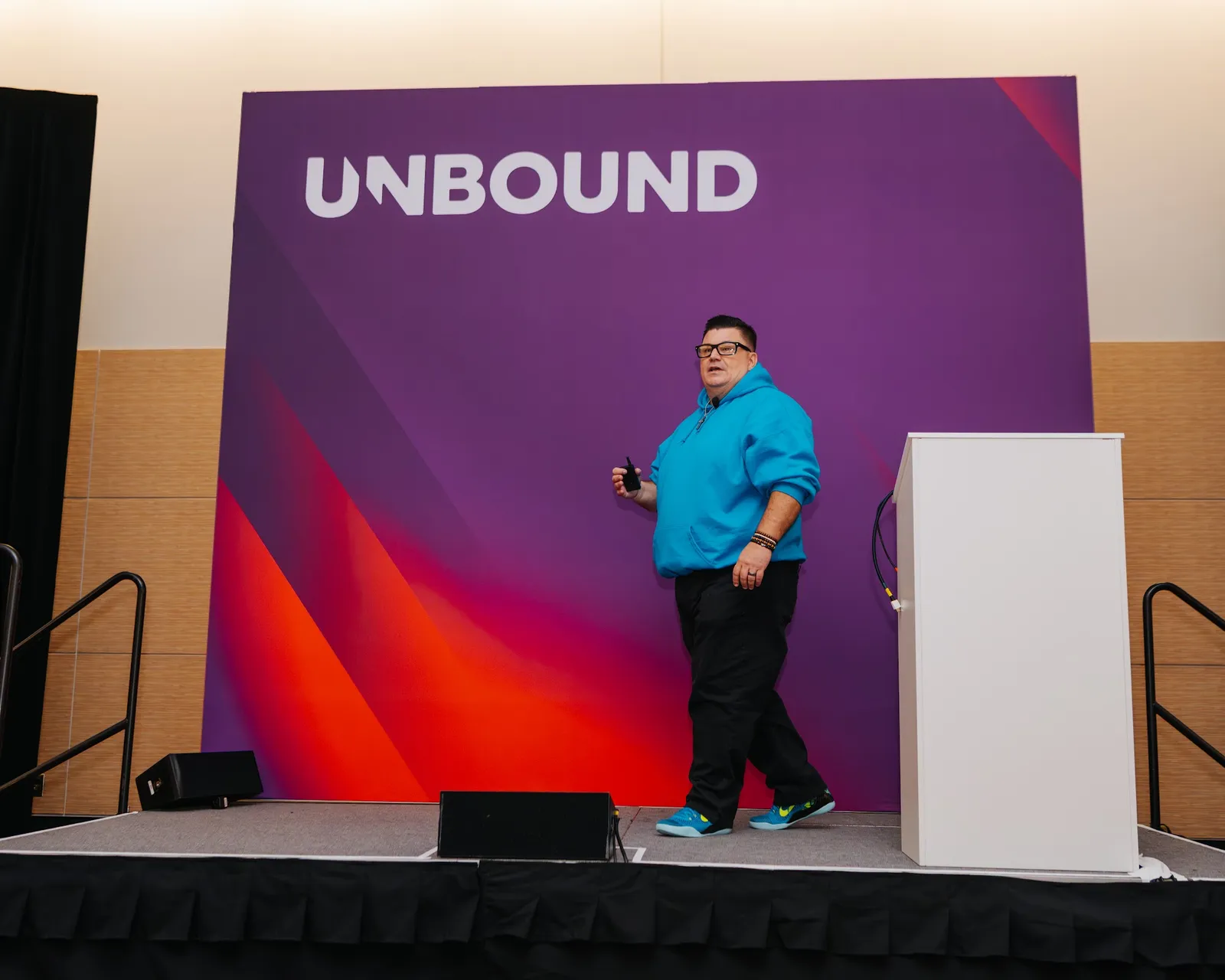
When I got to the last layer in my UNBOUND 2026 session, I asked what everybody thought Intelligence would be about. You can probably guess what most of the room said, and I wrote about that moment in Serve From Stage, Never Pitch From Stage.
It's not AI. "What I mean by this is reporting."
I saved it for last on purpose, "because this is the layer that decides whether the other four add up or just add on." And I've watched the same thing for years with the marketers I talk to. For most teams, reporting is their Achilles heel. "It's the thing that gets built last, trusted least, and acted on almost never."
Built last, because there's always something louder. Trusted least, because deep down you're not sure the numbers are right. And acted on almost never, "because the report was built to answer somebody's question and not built to drive anybody's decision."
This is Layer 5 of the five-layer system, and the one that closes the loop. The full map is in You Can't Out-Tactic a Leaking System. The mindset behind this layer is AI-Assisted.
The Deck That Gets Admired on Thursday
Here's the ritual. We pull the report because somebody asked for it. We paste it into a deck. And then we go right back to doing what we were already doing. The data existed. It just didn't change anything.
I'm preaching to myself on this one. "We've all built the deck that gets admired on Thursday and forgotten by Friday."
That neglect has a cost. "Without this layer, the other four can be individually excellent and collectively blind." You can be doing almost everything right and have no idea which parts are working.
You're not the only one feeling it. In the Content Marketing Institute's 2026 research, measuring content effectiveness was one of the top three challenges B2B marketers named. It isn't a data shortage. Most of us are drowning in data. It's a decision shortage.
Museum or Control Room
Picture two rooms with the exact same data in them.
The first room is a museum. "The numbers are up on the wall, nicely framed, professionally lit. Everybody walks past and admires them and nothing moves." There's even "a guided tour once a month. It's called the Marketing Review Meeting." Everybody nods at the exhibits, says "very interesting" at the traffic chart, and files out. Nobody touches anything. Velvet ropes.
The second room is a control room. Same numbers, down to the decimal. "But every one of those numbers has a hand on a lever. A number moves, somebody acts." Somebody owns that number, and "somebody's job description says: when this moves, you move."
"One is where numbers go to be remembered, the other is where numbers go to matter."
That's the anchor for this layer:
"A dashboard nobody acts on is a museum. Intelligence is a control room."
And be careful answering which room you're in too fast, because "owning a dashboard tool doesn't make it a control room. Plenty of museums have very expensive frames."
Don't Be the Tour Guide
Intelligence isn't more reporting. It's reporting you act on, fast, with a team that can read it without you in the room.
"If you're the only person who can interpret the numbers, you're not running a control room. You're a tour guide in a museum."
Here's the shortest way I know to say it: "Data is what happened, intelligence is what happens next."
When I was asked recently what I see over and over, my answer was blunt: "Most folks want reports and dashboards but never look at them. And rarely make decisions from the intelligence!" And the one habit that changes it? "Tie the numbers to human action!"
Speed matters here too. Jeff Bezos put it well in his 2016 letter to Amazon shareholders: "most decisions should probably be made with somewhere around 70% of the information you wish you had. If you wait for 90%, in most cases, you're probably being slow." He also pointed out that many decisions are reversible, two-way doors. Most marketing decisions are two-way doors. Change the subject line. Move the button. Pause the campaign. If your control room waits for perfect data before anyone touches a lever, it's a museum with better lighting.
Worked Example: Radar, Research, Revenue
The easiest way I know to show a number wired to human action is how I've taught lead scoring for years. It's called Radar, Research, Revenue.
Most lead scores are museum pieces. A number sits on a contact record, and nobody knows what it means. As I said on HubHeroes, the real question is, "what does the number mean?" So we give each band of the score a meaning and an action.
- Radar. The contact owner should know the name. "They don't really need to take any actions yet, but they should [be] familiar with the name." In my words from the show: "The butter's starting to rise to the top, but it doesn't mean let's go for the jugular yet."
- Research. Now they've done enough that it's time to learn more. Marketing might send a survey, a poll, or a form with a couple of special questions. Sales might look at the website, their social profiles, and connect on LinkedIn.
- Revenue. An internal notification goes to the sales rep: this human's score says we should have been talking yesterday, so schedule a conversation as soon as possible. And the notification carries a reverse-engineered lead sheet, the 7 to 10 pieces of information sales told us they need before they reach out.
"We literally built lists and emails and workflows all around this thing that is radar research revenue. So you could take action upon the information."
We built ours in HubSpot, but you can do this in your CRM. The tool doesn't matter. What matters is that every band of the number has a hand on a lever.
Worked Example: Four Museums, One Control Room
A client we worked with, RetroFoam, was running four separate business entities, and their numbers lived in four separate places. Four museums. Four sets of walls. Four monthly tours. Nobody could see the whole picture, so nobody could act on the whole picture.
We helped them pull it into one owned dashboard: four separate business entities, one owned dashboard, one control room that tells them where to act. You can read the RetroFoam case study for the full picture.
Catch that word, owned. Not rented from a tool they might churn off next year. Not trapped behind a platform's export button. Theirs. "Your intelligence layer should belong to you because it's the memory of your whole system. Lose it, and the system forgets everything it learned. And a system with no memory, it can't compound."
Where AI Fits in the Control Room
The mindset for this layer is AI-Assisted, not AI-decided. AI is genuinely useful at spotting what changed in a pile of numbers, fast. Let it. Then a human decides what it means and what to do about it. And never ship a number an AI handed you that you haven't checked against the real data.
When I draw the line between what AI should do and what a human has to own, I land here: "Taste, review, ideation, strategy but strategy can be AI assisted." The machine can light up the control room. A human still pulls the lever.
The Loop Closes
This is where the whole system comes back around. Intelligence isn't the end of the line. It's the start of the next loop.
"Everything your control room learns flows back to the top. The questions buyers actually ask make your surface clearer. The stories that landed tell your engine what to capture next. The steps where humans hesitate show conversion exactly where to serve harder. The hours your operation saved get reinvested in all of it."
(At UNBOUND I still called Layer 3 "conversion." It's Conversation Infrastructure now.)
That's what compounding looks like. Not more tactics. A system that learns and comes back around smarter every pass.
Score Your Intelligence
Rate each statement 1 to 5 (1 Broken, 5 Dialed in).
- Our numbers drive decisions; they don't just get reported and forgotten.
- When a metric moves, we act on it quickly.
- Our team can read and act on our reporting independently.
- We trust our data enough to make real decisions on it.
- What we learn feeds back into what we do next; we don't start each campaign from scratch.
Pick One. Start Monday.
That's all five layers. Surface, Content Engine, Conversation Infrastructure, Operations, Intelligence. If you've been scoring yourself as you read this series, you know which one is lowest. That's your highest leverage. Pick it. Start Monday. Make it more powerful, more human, and more simple.
Please fall back in love with your marketing.
If you want to see your five layers side by side, the free scorecard gives you all five in about ten minutes. And if you're ready to rebuild, the whole system, every layer's course, every worksheet, a coach grounded in your scores, and a re-score to watch it climb, is at marketing.sidekickstrategies.com. Get the system there.
If you'd rather talk it through, I'd love to hear what you're building. Here's how.
 Free fit call
Let's see if we're a fit
Bring where you are and where you want to go. We'll figure out the next step together, even if that step isn't working with me.
Curious where you stand? Take the 3-minute AI readiness assessment.