Part 2
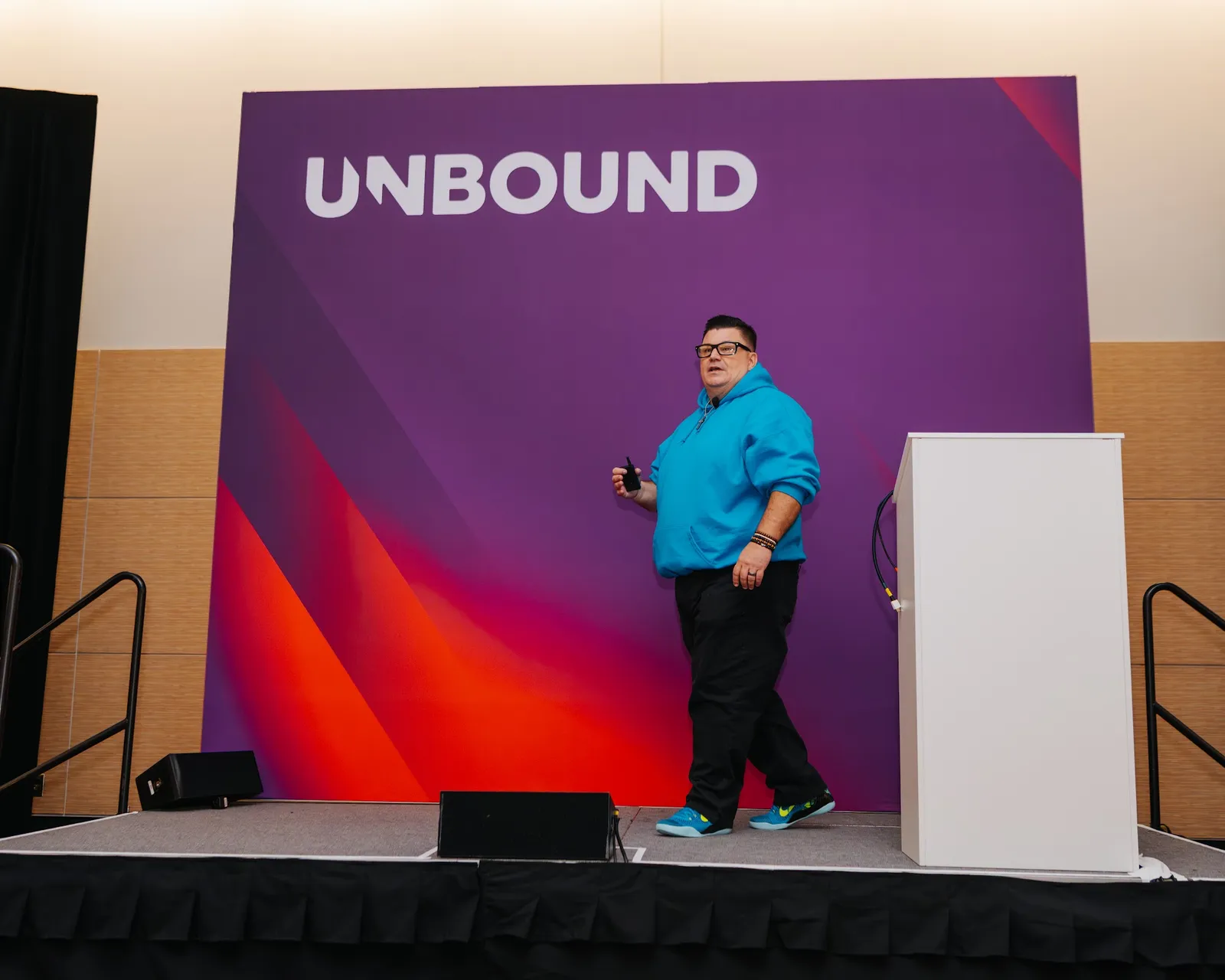
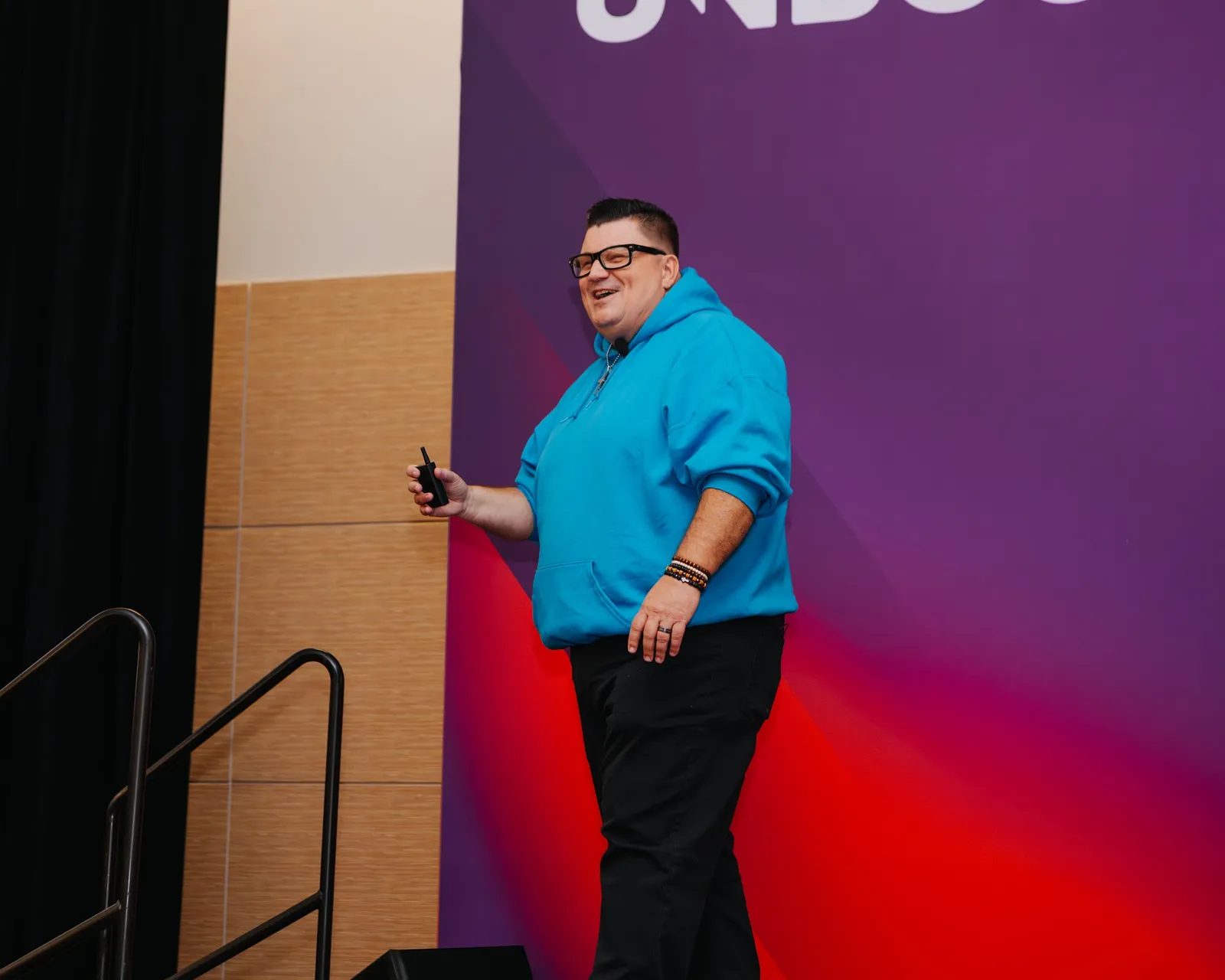
Surface is the handshake layer. Your website, your messaging, the first few seconds anybody spends deciding whether you're worth their time. And I said "anybody" on purpose when I taught this at UNBOUND 2026, "because it's not just humans reading your surface anymore. The machines are reading it too."
They always have. They're just smarter now, and they decide whether to repeat what you say to everybody else.
That's why the hard thing about this layer was never getting seen. "It's sounding human at scale."
If you're new to this series, start with You Can't Out-Tactic a Leaking System, where I lay out all five layers. This one is the top of the stack, and the mindset behind it is Human-Powered.
Meet Baby Bot
For a couple of years, we all treated the algorithm like a hungry little baby robot. Wide eyes, mouth open, saying "feed me, feed me, feed me keywords, feed me exact match phrases, feed me the words the machine wants."
And as humans, guess what we did? "We wrote for the robot."
You've read pages that sound like that baby robot wrote them. I've written a few. Every sentence stuffed so full of keywords there was no room left for an actual human. "We hired talented writers and then turned around and asked them to sound like databases." We optimized the humanity right out of our own websites, with good intentions, because we honestly believed that's what the baby wanted.
Here's the thing nobody told us. The baby grew up.
"The grown up version doesn't want to be fed keywords. It wants what a human wants."
The New Rule of This Layer
So here's the anchor for Surface, and if you write one thing down, make it this:
"The machine doesn't reward you for writing for the machine. It rewards you for being so clear to a human that you're easy to quote."
Hold onto that word, quote.
Picture the two readers of your homepage: a human and a machine. For years we thought we had to write two different things, one for the person and one for the crawler. Turns out they want the exact same thing: "A page so clear that a person gets it in one read. And a machine can lift one clean sentence and say, This is what these folks do."
That gives you a test you can run today. Could someone who never met you land on your homepage and finish this sentence out loud? "These folks help ____ do ____." If a human can finish it in one read, a machine can lift it. If a human squints, the machine moves on to somebody clearer, most likely your competition.
"Clarity for the human is the optimization for the machine on your page."
This isn't just me being optimistic. Google's own guidance for site owners says the SEO best practices that already matter still apply to AI Overviews and AI Mode, that "there are no additional requirements" and no "special optimizations necessary," and that you don't need new machine-readable files, AI text files, or special schema to show up there. What it points you back to is helpful, reliable, people-first content. In other words: the grown-up robot wants what the human wants.
And the human is deciding fast. Nielsen Norman Group's eyetracking research found that people spend more than half of their page-viewing time on the first screen. Your headline and the line under it are most of the conversation.
Quotable Isn't the Same as Quoted
Now, I have to give you the honest amendment, because the game moved again.
"Clarity makes you quotable... It doesn't make you quoted. And those are two totally different things."
"The machine won't quote a stranger." It quotes the names it sees corroborated everywhere else: talked about, cited, showing up in more places than your own website. So write clean for the human. That's your ticket to the table. Then go get talked about by the world.
That's why your surface is bigger than your website. When I taught this, I drew it in four parts:
- Owned: your site, your pillar pages, your newsletter. "The only one with no algorithms standing between you and a human."
- Rented: LinkedIn, YouTube, podcast feeds. Real reach, borrowed, and "the rules can change tomorrow."
- Earned: Reddit, review sites, other people's shows. "That's not what you say about you. That's what the world says about you."
- Assembled: ChatGPT, AI Overviews, Perplexity, Claude. "You don't publish there, you get assembled in these places."
"Owned makes you quotable. Earned makes you quoted. And rented gets you from point A to point B."
One more reason consistency across all of those matters. Gartner surveyed B2B buyers and found that 69% reported inconsistencies between what was on a company's website and what its sellers told them. If humans notice the mismatch, so will the machine assembling an answer about you. Say who you are the same way everywhere. And Gartner predicts that by 2028, 90% of B2B buying will be AI agent intermediated. A prediction, not a fact, but a good reason to make sure your first reader, human or not, can tell what you do.
What a Human-Built Surface Looks Like
When I look at a site, the first tells I check for are simple: "Resource center, pricing page, I immediately on the home page know I'm in the right place and this company helps solve my problem."
That pricing page matters more than most teams want to admit. "Being upfront and honest is important. Showing price helps the human make a faster decision. Even if it is a range." That's They Ask, You Answer thinking, the way my friend Marcus Sheridan has taught it for years, and it's still the best answer-engine strategy I know.
And the most common failures? "So many use jargon... They don't get specific enough." Too many homepages don't speak to the reader with "you" and "your." And the big one: "What they have could be on any website."
If your headline could be pasted onto a competitor's homepage and nobody would notice, it isn't a surface. It's wallpaper.
Worked Example: Nine Brands, One Surface
A client we worked with, SafeSplash, came to us carrying nine different brands. Nine brands meant nine surfaces and nine ways of saying who they were. Think about that from our two readers' point of view. A human lands and gets confused, and "confused humans don't buy." A machine crawls it and can't find one clean sentence to lift, because there might not be one.
Here's what the system looked like under the hood. We built one website on HubSpot's CMS, powered by HubDB, a database inside HubSpot. Each brand got one page that pushes out to every location under it. Updating that one page updates them all. Want something to show up at some locations and not others? Tick a checkbox in a database row. You can build the same idea in whatever CMS and CRM you run. The tool isn't the point. As I put it in the talk: "System thinking. How can we do the most with the least."
After we rebuilt their site system across nine brands, Q1 leads grew an average of 17% year over year. That's our work with a client, not a third-party study, and you can read the full SafeSplash case study. And it wasn't a secret keyword. It was a surface that finally said one clear thing.
Now let's make it small enough to do on your own homepage this week. Here's an illustrative before and after, not a client:
- Before: "Innovative, world-class solutions for modern growth."
- Run the tests: Do I know what they do? No. Who it's for? No. What to do next? No. Would I say "innovative, world-class solutions" to a friend over coffee? Never.
- After: "We help family-owned HVAC companies book more service calls from their website. See how it works."
- The machine test: Can a machine lift one clean sentence? Yes: these folks help family-owned HVAC companies book more service calls.
Same company. Same offer. One version is a brochure. The other one is a handshake.
Score Your Surface
Rate each statement 1 to 5 (1 Broken, 5 Dialed in). Be honest. Nobody sees it but you.
- A stranger can tell what we do, who it's for, and what to do next, in five seconds.
- Our homepage sounds like a person, not a press release.
- We lead with what the customer gets, not how great we are.
- An answer engine could lift one clean sentence that explains what we do.
- Our surface is built so a machine understands it: clear headline, real answers, clean navigation.
Add them up out of 25. If one of those made you wince, that's your starting point.
Where Surface Hands Off
A clear surface makes a promise. The next layer has to keep it. Once you're quotable, the way you become quoted is by shipping true stories, consistently, often enough that other humans and other machines start repeating them. That's the job of the Content Engine, and it's where we go next.
Remember what Baby Bot grew up into. He doesn't want keywords. He wants what a human wants. Serve the human, and the machine follows.
If you want to see where Surface ranks against your other four layers, the free scorecard takes about ten minutes. And if you want the full Surface course in my voice, the worksheet, and a coach that knows your scores, get the system at marketing.sidekickstrategies.com.
If you'd rather talk it through, I'd love to hear what you're building. Here's how.
 Free fit call
Let's see if we're a fit
Bring where you are and where you want to go. We'll figure out the next step together, even if that step isn't working with me.
Curious where you stand? Take the 3-minute AI readiness assessment.